
What Is Financial Astrology? A Beginner’s Guide
When we think about financial markets, we usually think of economics, interest rates, company earnings, inflation, government policy, investor sentiment, and global events. These are the foundations of conventional financial analysis.
But there is another, much older approach that attempts to study financial and economic cycles through the movements of the planets.
This field is commonly referred to as financial astrology.
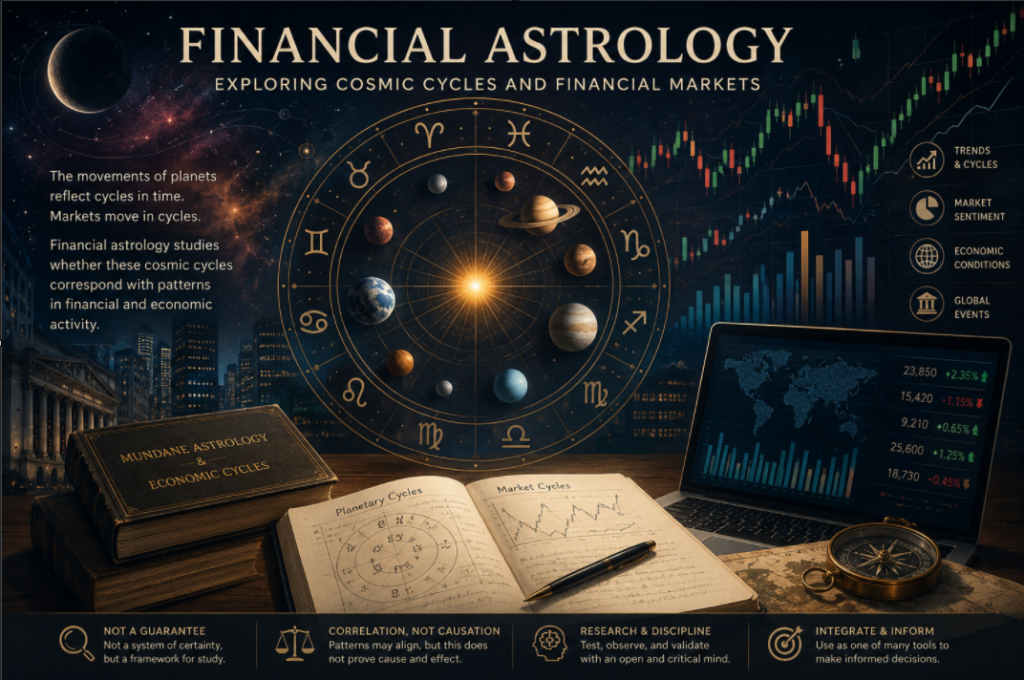
Financial astrology applies astrological principles to questions involving money, commodities, financial markets, economic cycles, and periods of expansion or contraction. Depending on the tradition being followed, it may draw upon mundane astrology, natal astrology, planetary cycles, transits, ingresses, eclipses, and other astronomical or astrological phenomena.
What Does Financial Astrology Mean?
At its simplest, financial astrology is the study of financial and economic phenomena through astrological cycles.
The underlying idea is that financial markets are not completely random expressions of numbers. They are also collective human systems.
Markets are driven by millions of decisions made by people, institutions, governments, businesses, and investors. These decisions are influenced by psychology, expectations, fear, optimism, uncertainty, confidence, and collective sentiment.
Financial astrology attempts to investigate whether planetary cycles and configurations correspond with changes in these collective patterns.
Depending on the astrologer and tradition, this can involve studying:
- Planetary transits
- Planetary conjunctions and oppositions
- Retrograde cycles
- Eclipses
- Sign ingresses
- New Moons and Full Moons
- Long-term planetary cycles
- Planetary relationships with particular signs and houses
- Historical market turning points
- Mundane charts for countries, markets, or institutions
- Natal charts of individuals involved in financial activity
In other words, the central question is not “Will the market go up or down tomorrow?”
A more meaningful question is “Do certain astronomical or astrological cycles repeatedly coincide with changes in financial market behavior?”
That distinction becomes important when approaching the subject scientifically and responsibly.
Astrology and Financial Markets: A Historical Connection
The relationship between astrology and economic activity is not entirely new.
For much of recorded history, astrology was not separated into the modern categories of “personal astrology,” “financial astrology,” and “mundane astrology.” Astrological observations were frequently applied to matters concerning kings, kingdoms, agriculture, weather, wars, trade, crops, and collective events.
This broader field is generally associated with mundane astrology, which deals with collective or worldly affairs rather than the horoscope of an individual. Economic life was naturally part of this broader picture.
Historically, astrologers paid considerable attention to commodities and agricultural conditions because economies were heavily dependent on crops, livestock, weather, metals, and other physical resources. This is important when understanding the development of financial astrology.
Modern financial markets are relatively recent compared with the history of astrology. Stock exchanges, derivatives markets, electronic trading, and globally interconnected financial systems are modern developments.
Consequently, financial astrology did not begin with a ready-made ancient system specifically designed to predict the S&P 500, NIFTY, Dow Jones, or individual technology stocks.
Instead, astrologers gradually attempted to adapt older astrological relationships involving commodities, resources, economic conditions, and collective events to modern financial markets.
For example, if an astrological tradition associated a particular planet with a commodity or economic sector, astrologers began exploring whether the same planetary symbolism could have relevance to modern financial instruments connected with that commodity or sector.
This is one reason financial astrology contains a mixture of traditional astrological symbolism and later interpretations developed around modern markets.
Two Major Branches of Financial Astrology
Financial astrology can broadly be divided into two different approaches:
1. Individual Financial Astrology
This approach studies the financial potential and financial timing of an individual. Here the astrologer works primarily with a person’s birth chart.
Relevant questions may include:
- What are the individual’s financial strengths?
- Which periods may be more supportive for wealth creation?
- When might financial pressure increase?
- What types of work or business may be financially suitable?
- How might major planetary periods affect income?
- Are there periods associated with greater financial risk-taking or caution?
In a Vedic astrology framework, this can involve examining factors such as:
- The 2nd house and its lord
- The 5th house and speculative activity
- The 9th house and fortune
- The 10th house and profession
- The 11th house and gains
- Relevant planetary combinations
- Planetary strengths
- Dashas and sub-periods
- Transits
- Divisional charts where appropriate
The objective is to understand the financial tendencies and timing within an individual’s life which is entirely different from predicting the movement of the entire market.
2. Market Astrology
Market astrology looks outward rather than inward. Instead of beginning with an individual’s birth chart, the astrologer studies the chart of a market, country, exchange, company, commodity, or financial event.
The astrologer then compares these charts with planetary transits and cycles. The purpose is to investigate whether particular astrological configurations correspond with Market rallies, Market declines, Increased volatility, Major reversals, Periods of consolidation, Sector rotations, Commodity cycles and Economic expansion or contraction
This is where financial astrology becomes particularly interesting—and also particularly difficult to test.
What Do Financial Astrologers Actually Try to Predict?
The popular image of financial astrology is often something like: “Saturn is entering a particular sign, therefore the market will crash.”
Real financial astrology can be considerably more nuanced than that. Astrologers may attempt to identify periods of increased probability or changing market conditions, rather than claim that one planetary event mechanically determines one market outcome.
Some astrologers focus on time cycles. For example, they may investigate whether historical market turning points tend to cluster around particular planetary cycles.
Others focus on planetary symbolism. A planet may be associated with particular commodities, industries, psychological themes, or economic processes, and these associations are then tested against historical data.
Others combine several techniques. So while studying financial astrology, following questions become relevant –
- Is there a significant planetary cycle occurring at the same time as a historically important market cycle?
- Does a particular planetary configuration repeatedly appear near major market turning points?
- Does the astrological picture suggest a period of increased volatility rather than a definite direction?
This approach is much more useful than treating astrology as a collection of simple “buy” and “sell” signals.
Correlation Is Not the Same as Causation
This is perhaps the most important concept for anyone studying financial astrology. Suppose we discover that a particular planetary configuration occurred near ten major market turning points.
That observation may be interesting. But it does not automatically prove that the planetary configuration caused the market movements.
This is the difference between correlation and causation. Two events can occur together without one causing the other. For example, imagine that ice-cream sales increase at the same time that people visit beaches more frequently.
There is a correlation between the two. But ice-cream sales do not cause people to go to the beach. A third factor—such as warmer weather—may influence both.
The same principle must be applied when studying astrology and financial markets.
If a planetary cycle repeatedly coincides with market movements, several possibilities exist:
- The relationship may be meaningful.
- The relationship may be coincidental.
- The relationship may be produced by another underlying factor.
- The relationship may appear strong in one historical period but disappear in another.
- The pattern may be the result of selective observation or hindsight.
Therefore, a historical correlation should be viewed as a starting point for further investigation, rather than as conclusive evidence.
Why Backtesting Matters
This is also why historical testing is important. Suppose an astrologer notices that a particular planetary configuration appeared before several historical market declines.
It would be easy to look backward and create a convincing narrative. But a stronger approach would be to define the astrological condition before examining the results, and then test it against a sufficiently large historical dataset.
For example:
- Define the planetary configuration.
- Define what constitutes a market event.
- Establish the time window being studied.
- Examine historical occurrences.
- Record both successful and unsuccessful instances.
- Compare the results against an appropriate baseline.
- Test the relationship on data that was not used to develop the hypothesis.
This helps reduce the risk of confirmation bias.
Financial Astrology is not a Guaranteed Prediction System
Financial markets are extraordinarily complex. They are influenced by countless variables, that can include :
- Government decisions
- Central-bank policies
- Wars
- Natural disasters
- Technological developments
- Corporate earnings
- Investor psychology
- Liquidity
- Political events
- Unexpected news
- Institutional positioning
- Global capital flows
No single analytical framework can reliably account for every one of these factors.
Astrology should therefore not be presented as a system that can guarantee that a particular stock or index will rise or fall at a particular time.
However with proper study and research astrology can prove to be a great supportive tool in understanding financial and commodity markets and making important financial decisions.
What Financial Astrology Can—and Cannot—Tell Us
It may be helpful to think of financial astrology in terms of its potential role.
Financial astrology may be used to explore:
- Market cycles
- Forecasting probability of market movements
- Potential periods of heightened volatility
- Historical turning points
- Commodity relationships
- Economic cycles
- Investor sentiment
- Individual financial timing
- Sector or asset themes
- Recurring planetary patterns
It should not be assumed to provide:
- Guaranteed profits
- Risk-free investments
- Exact future prices
- A substitute for due diligence
- A replacement for risk management
This distinction is crucial. A useful analytical framework does not have to predict every event perfectly to be worth studying. Its value may instead lie in identifying patterns, cycles, probabilities, or periods deserving closer attention.
The Right Way to Approach Financial Astrology
Financial astrology sits at an unusual intersection between astrology, astronomy, economics, market psychology, statistics, and historical research.
That makes it both fascinating and challenging. The most productive way to approach it is with two qualities that can sometimes seem contradictory:
Open-mindedness and skepticism.
Open-mindedness allows us to investigate patterns that may otherwise be overlooked while skepticism forces us to test those patterns rather than automatically accepting them.
A responsible study of financial astrology should therefore ask some important questions:
- What exactly is the astrological hypothesis?
- How was the relationship originally derived?
- Does it work across different historical periods?
- How frequently does the configuration occur?
- How often does the predicted outcome fail?
- Could another variable explain the observed relationship?
- Does the relationship remain significant when tested statistically?
These questions can make the research more meaningful.
What are the Next Steps?
Understanding what financial astrology is provides only the starting point. The next step is to understand how astrologers map traditional planetary symbolism onto modern financial markets.
Why is gold associated with certain planetary principles?
How did relationships originally developed for commodities become connected with modern stocks and sectors?
Which planets are traditionally associated with wealth, trade, speculation, commodities, and economic activity?
And how can these principles be interpreted within a Vedic framework?
These questions form the foundation for developing a more systematic approach to financial astrology.
In the articles that follow, we will gradually move from these basic concepts toward the houses, planets, signs, karakas, commodities, sectors, planetary cycles, and timing techniques used in financial astrology.
The objective is not simply to learn a list of planetary associations, but to understand the reasoning behind them and how they can be tested against real-world financial data.

One Comment