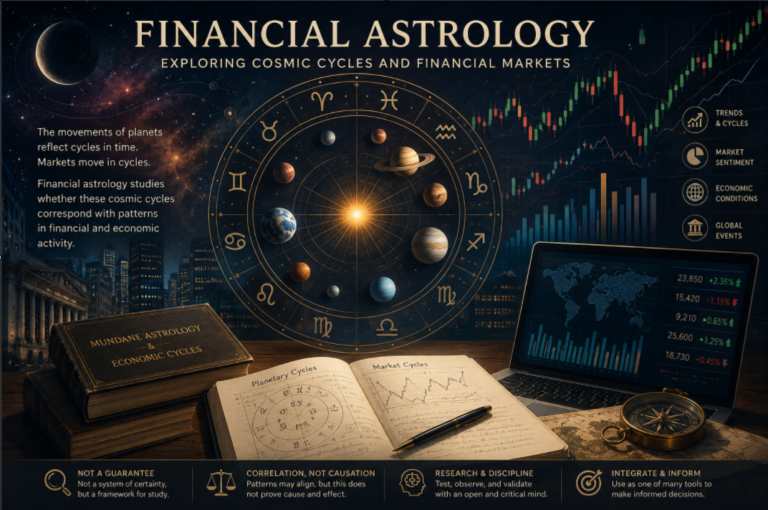
A Brief History of Financial Astrology
When people hear the term financial astrology, they often imagine something relatively modern: an astrologer looking at a stock chart and trying to determine whether the stock will go higher or lower. While this is relatively a modern practice, the history of financial astrology is considerably older—and more interesting—than modern stock markets.
Financial astrology did not begin with the New York Stock Exchange, stock indices, or cryptocurrency. Its earlier roots can be found in humanity’s attempts to understand the relationship between celestial cycles, seasons, weather, agriculture, commodities, and economic conditions.
Over centuries, these ideas gradually developed from observations of the natural world into systems for studying commodity prices, economic cycles, and eventually financial markets.
A useful way to understand this evolution is:
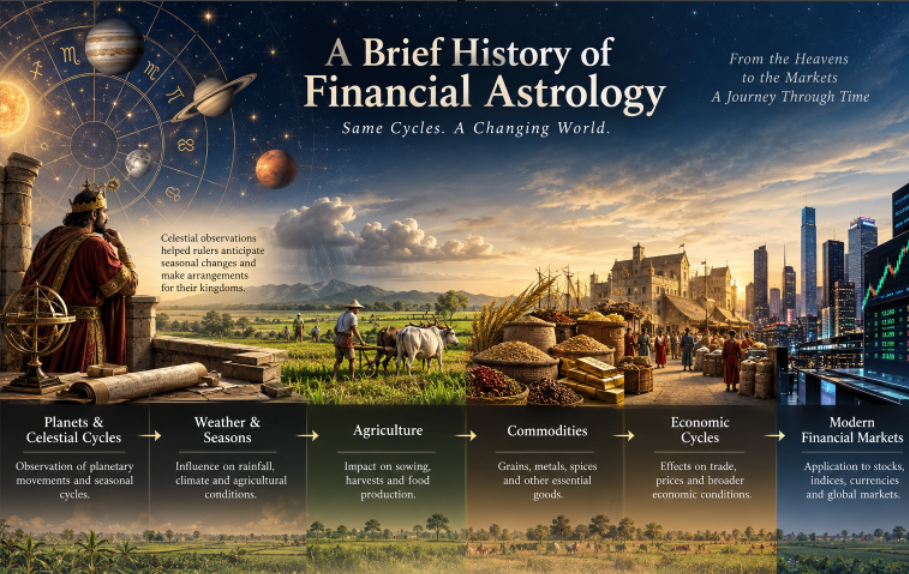
Planets → Agriculture & Weather → Commodities → Economic Cycles → Financial Markets
This historical progression is important because it shows that the idea of applying astrology to markets was not simply created by someone assigning a planet to the stock market. It developed from older traditions of mundane astrology, celestial observation, agricultural forecasting, and commodity symbolism.
The Beginning: Looking at the Sky to Understand Life on Earth
Long before modern economics existed, agriculture was the foundation of most economies.
For an ancient society, knowing when to sow crops, when seasonal rains were likely to arrive, and when harvest conditions might change could have enormous economic consequences.
The sky provided one of the most reliable calendars available to early civilizations.
The movements of the Sun and Moon provided obvious recurring cycles, while the rising and setting of stars and planets helped ancient societies organize the agricultural year. Historical evidence shows that celestial observations were closely connected with calendars, seasonal changes, and agricultural activity. Hesiod’s Works and Days, for example, contains instructions connecting celestial appearances with agricultural and sailing activities.
From Agriculture to Commodities
As societies became more organized around trade, agricultural products became commodities with economic value. Grain, wheat, cotton, spices, livestock and other essential goods could experience significant changes in availability depending on weather, harvests, transportation and political conditions.
Consequently, anything that could potentially provide information about seasonal or agricultural conditions became economically important. This is where mundane astrology becomes particularly relevant.
Mundane astrology traditionally concerns collective events rather than individual birth charts. It has historically been used to examine matters such as kingdoms, rulers, wars, weather, agriculture and major social developments.
The Agricultural connection
A poor harvest could lead to scarcity. Scarcity could lead to higher prices. Higher prices could affect merchants and consumers. And widespread changes in food prices could influence the broader economy.
Therefore, the chain could be represented as:
Celestial/seasonal observations → Weather → Agriculture → Supply → Commodity prices → Economic conditions
These celestial observations could then be used to prepare for potential shortages, manage food reserves, plan agricultural activities, and make arrangements for trade and other economic needs. This is one of the historical pathways through which astrology and economics became connected.
Planetary Associations With Metals and Commodities
Another important development was the symbolic association of planets with particular materials and commodities.
The traditional seven visible planets—the Sun, Moon, Mercury, Venus, Mars, Jupiter and Saturn—became associated with different metals in the classical astrological and alchemical traditions.
One widely used traditional correspondence was:
| Planet | Traditional Metal Association |
| Sun | Gold |
| Moon | Silver |
| Mercury | Mercury |
| Venus | Copper |
| Mars | Iron |
| Jupiter | Tin |
| Saturn | Lead/ Oil |
These associations were part of a much broader symbolic system connecting planets, metals, days of the week and other natural phenomena. This is significant for the development of commodity astrology.
Gold and silver, for example, were not merely abstract financial instruments. For much of human history they were physical stores of wealth, money, jewellery and important trade commodities.
Therefore, the symbolic relationship between celestial bodies and metals could eventually become relevant to attempts to study the behavior of commodity markets.
It is worth emphasizing that these traditional planetary-metal associations are historical astrological correspondences, not established scientific relationships between planets and commodity prices.
The Indian Tradition: Price Astrology and the Brihat Samhita
The historical development becomes especially interesting when we look at the Indian astrological tradition.
Indian astrology developed a substantial branch of mundane astrology, traditionally concerned with collective events, weather, agriculture, political conditions and other matters affecting society. One particularly important historical text is Varahamihira’s Brihat Samhita, generally dated to the 6th century CE.
Unlike texts primarily concerned with individual birth charts, the Brihat Samhita is an extensive compendium covering subjects including weather, agriculture, omens, astronomy, natural phenomena and economic matters. Importantly, it contains material dealing specifically with prices and commodities.
The section traditionally known as Arghakanda, or the section concerning prices, discusses methods of interpreting changes in commodity prices using astronomical and astrological factors. The text also contains material concerning agricultural conditions, rainfall and the association of different substances and commodities with astrological factors.
This is historically important because it provides a much clearer connection between astrology and prices than simply saying that ancient people watched the planets.
It demonstrates that the idea of asking whether celestial configurations could correspond with changes in commodity conditions existed within a classical astrological framework centuries before modern stock exchanges.
Why Commodities Came Before Stocks
There is a simple economic reason why commodity astrology naturally preceded stock-market astrology.
Modern stocks represent ownership interests in companies. But companies, stock exchanges and modern financial markets are relatively recent institutions. Commodities, on the other hand, have existed for thousands of years.
People have always needed Food, Grains, Metals, Livestock, Textiles, Fuel and Other essential resources. And the prices of these goods have always responded to changes in supply, demand, weather, politics and trade.
Therefore, if an astrologer wanted to investigate whether celestial cycles corresponded with economic conditions, commodities were a much more obvious place to begin.
The following historical progression becomes relevant:
Agriculture → Commodity supply → Commodity prices → Trade → Economic cycles → Financial markets This is one reason the history of financial astrology should not begin with stocks.
From Commodity Cycles to Economic Cycles
The next major step was the recognition that individual commodity movements were part of larger economic patterns.
A strong agricultural cycle could influence food prices. Commodity shortages could influence inflation. Changes in industrial demand could influence metals. Political developments could affect trade. Credit conditions could influence investment.
Eventually, observers began looking beyond individual commodities and asking whether broader economic cycles existed. This created an important bridge between commodity astrology and financial astrology.
Astrologers began examining longer planetary cycles and attempting to associate them with periods of:
- Economic expansion
- Contraction
- Inflation
- Deflation
- Financial stress
- Speculation
- Political instability
- Major market transitions
Planetary cycles such as the Jupiter-Saturn cycle later became particularly important within some schools of financial and mundane astrology. Modern financial astrology literature continues to examine planetary cycles as possible markers of longer-term economic and market phases.
Again, these are astrological interpretations rather than established economic laws. Their historical significance lies in the development of a framework for studying recurring cycles.
The Arrival of Modern Financial Markets
The emergence of organized stock exchanges created an entirely new environment for financial astrology. Instead of observing only grain, metals or agricultural commodities, astrologers could now examine:
- Stock prices
- Market indices
- Bonds
- Currencies
- Commodity futures
- Financial institutions
- Individual companies
The development of market data also made something possible that ancient astrologers simply did not have i.e large quantities of historical price information.
Once historical price series became available, astrologers could compare planetary cycles with market peaks, troughs and major turning points.
This gradually transformed financial astrology from a predominantly symbolic tradition into something that increasingly attempted to operate as a form of market-cycle analysis.
W.D. Gann and the Development of Market Astrology
One of the most famous names associated with this transition is W.D. Gann.
William Delbert Gann was active in the early 20th century and worked extensively with both stocks and commodities. His career included market forecasting, newsletters and books, and he became particularly associated with the study of price, time, geometry and cycles.
Gann is frequently described as one of the pioneers of financial astrology because of his use of planetary and cyclical concepts alongside mathematical and geometric techniques. His work is particularly relevant to the history of financial astrology because it illustrates an important transition:
Astrology was no longer being considered only in relation to agriculture or commodity prices. It was being incorporated into attempts to forecast organized financial markets.
Gann’s early career was strongly connected with commodity markets, including cotton, before his work expanded into stocks and broader market forecasting.
His methods remain controversial and are interpreted differently by different researchers, but historically he occupies an important position in the development of modern financial astrology.
From Commodities to Stocks: The Idea of Relationships
Another important development was the realization that markets do not operate in isolation. There is an interconnected relationship between how a commodity can influence an industry, An industry can influence companies and how companies can influence stock prices and indices.
And major changes in commodities can sometimes have very different implications for different sectors. For example, energy prices can have very different effects on:
- Oil producers
- Airlines
- Transportation companies
- Chemical manufacturers
- Consumers
Similarly, precious metals can behave differently from industrial metals, while agricultural commodities can respond to entirely different fundamental forces. This led financial astrologers to investigate not only the direct relationship between planetary cycles and an individual market, but also relationships between different markets.
The Development of Stock-Market Astrology
By the 20th century, several astrologers were explicitly attempting to apply astrology to stock-market forecasting. Following the early work associated with Gann, other researchers and astrologers experimented with:
- Planetary aspects
- Planetary ingresses
- Lunar cycles
- Planetary stations
- Long-term planetary cycles
- Market birth charts
- Stock-exchange charts
- National charts
- Historical market cycles
The period following the Great Depression was particularly important. Researchers became increasingly interested in understanding economic cycles and whether recurring patterns could be identified in financial data. Historical accounts of financial astrology document the emergence of market-focused publications and theories during the early and mid-20th century.
One example is Louise McWhirter’s 1938 The McWhirter Theory of Stock Market Forecasting, which attempted to connect long-term market behavior with astrological cycles.
Whether these theories are ultimately predictive is a separate question. Historically, however, they demonstrate that financial astrology had evolved into an explicit attempt to study organized financial markets.
From Stock Markets to Global Financial Markets
The scope of financial astrology has continued to expand. Modern financial markets are no longer limited to stocks and commodities.
Today, traders and researchers study:
- Equities
- Stock indices
- Gold and silver
- Crude oil
- Natural gas
- Agricultural commodities
- Foreign exchange
- Interest rates
- Bonds
- Cryptocurrencies
This creates a much broader field of study. The same historical principle can be applied at different levels:
Level 1 — Planetary cycles
Study recurring celestial configurations.
↓
Level 2 — Commodity relationships
Examine possible relationships with gold, silver, oil, agricultural commodities and other markets.
↓
Level 3 — Economic cycles
Study inflation, growth, contraction, liquidity and broader economic conditions.
↓
Level 4 — Financial markets
Investigate whether these cycles correspond with movements or turning points in equities, currencies, indices and other financial instruments.
This is essentially how the modern financial astrology has evolved.
Financial Astrology Is Not the Same as Conventional Financial Analysis
It is also important to distinguish financial astrology from conventional financial analysis. Fundamental analysis examines factors such as Revenue, Earnings, Cash flow, Interest rates, Valuations, Economic growth, Supply and demand.
Technical analysis mainly deals with Price, Volume, Trends, Momentum, Support and resistance and Chart patterns
While Financial astrology includes another framework of Planetary cycles, Astrological aspects ,Ingresses, Lunar cycles, Mundane charts, Historical correlations and Time cycles.
For this reason, financial astrology is best understood as an alternative or supplementary analytical framework, rather than a replacement for established financial analysis.
It becomes our responsibility to mention here that there is also no established scientific evidence demonstrating that planetary positions causally determine financial-market prices; astrology is generally regarded by mainstream science as a pseudoscientific practice.
That distinction is important, particularly when financial decisions are involved.
A Tradition That Evolved With the Economy
Financial astrology did not begin with stocks. Its broader historical journey can be understood as an evolution:
Planets → Seasons → Agriculture → Commodities → Prices → Economic Cycles → Financial Markets
The ancient world was primarily concerned with agriculture and the natural environment. As economies became increasingly dependent on trade and commodities, astrologers began developing ideas about prices, materials and economic conditions. With the emergence of organized financial markets, these concepts were gradually applied to stocks, market indices and other financial instruments.
The work of figures such as W.D. Gann helped popularize the application of planetary cycles, time and market analysis in the modern financial era.
Today, financial astrology exists at the intersection of astrology, economic cycles, market history and financial analysis.
Whether one considers its planetary hypotheses symbolic, historical, exploratory or potentially predictive, understanding its origins provides an important perspective.