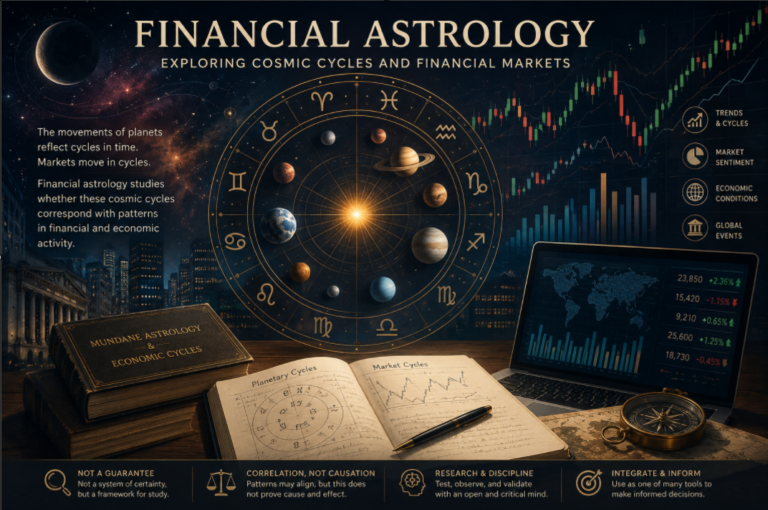
Why Are You Making Losses in Trading? The Role of Psychology and Astrology
Trading looks simple from the outside. You study a chart, identify a trend, enter a trade, place a stop-loss and wait for the market to move in your direction. Yet, in reality, many traders struggle to make consistent profits. They may have access to good strategies, sophisticated indicators, market news and years of experience—and still find themselves losing money.
So, what goes wrong?
Sometimes the problem is the trading strategy. Sometimes it is poor risk management. But very often, the problem lies somewhere deeper: the trader’s psychology, behaviour and personal circumstances.
There is also another perspective that some traders and practitioners of Vedic astrology consider: whether the individual’s astrological tendencies and current planetary periods might not be supportive of trading activity.
Astrology should not be viewed as a substitute for financial analysis or risk management. However, for someone who follows astrology, it can provides an additional framework for understanding temperament, decision-making patterns and periods when one may be more or less inclined toward speculative activity.
Trading Is Not Just About Finding the Right Strategy
One of the biggest misconceptions among new traders is that losses happen because they haven’t found the “perfect strategy.”
This often leads to an endless cycle:
Strategy → Loss → New Strategy → Loss → New Strategy
A trader may move from moving averages to RSI, then to price action, then Elliott Wave, then options strategies, then algorithmic indicators—without addressing the real issue. A profitable strategy can still produce losses if the person using it cannot follow its rules consistently.
Consider two traders using exactly the same system. Trader A enters according to the rules, accepts the predetermined stop-loss and walks away. Trader B enters late, moves the stop-loss when the trade goes against him, exits profitable trades too early and increases the position size after a loss.
They are using the same strategy but their results can be completely different. This is where trading psychology becomes extremely important.
You maybe your Biggest enemy
Financial markets continuously create emotional situations. When a trade is profitable, you may feel confident. When it starts falling, fear appears. After a series of losses, frustration develops.
And after a large winning trade, overconfidence can encourage you to take excessive risks. The market itself has not changed—but your behaviour has.
Some of the most common psychological problems include:
Fear
Fear can prevent a trader from entering a perfectly valid setup. After experiencing several losses, the trader may begin thinking: “What if this trade also fails?”
Eventually, the trader starts entering only after the market has already moved significantly.
Greed
Greed often appears after winning trades. A trader makes ₹10,000 and thinks: “I could have made ₹20,000.” The next trade is therefore larger. Then the next one is even larger. A single adverse movement can erase several previous gains.
Revenge Trading
Revenge trading can be one of the most damaging psychological barriers. After losing money, the trader wants to recover it immediately. A ₹5,000 loss becomes a reason to make a ₹10,000 trade. Then a ₹10,000 loss becomes a reason to take a ₹25,000 position. The objective has silently changed from following a trading system to recovering money.
Overconfidence
A series of successful trades can create the illusion that the trader has figured out the market. As a result position sizes increase. Stop-losses become wider. Risk management becomes less important. Eventually, one unexpected move can produce a disproportionately large loss.
FOMO
The fear of missing out can be particularly dangerous in fast-moving markets. A trader sees Bitcoin, gold, an index or a stock suddenly moving and thinks: “If I don’t enter now, I’ll miss the entire move.” The trader enters at an unfavourable price—not because the setup is valid, but because of emotional pressure.
The Problem May Not Be Your Knowledge
You can know exactly what you should do and still do the opposite. This is one of the most interesting aspects of trading psychology.
A trader may know:
- Always use a stop-loss.
- Never risk too much on one trade.
- Don’t revenge trade.
- Don’t chase the market.
- Follow the system.
- Don’t let emotions control decisions.
But knowing these rules intellectually is very different from following them when real money is at risk. Trading therefore becomes a test of behaviour under uncertainty.
You are not simply analysing the market. You are analysing the market while simultaneously managing your own emotional responses to uncertainty. And this is where astrology enters the discussion.
Can Astrology Influence Your Trading Behaviour?
Astrology does not need to be interpreted as a magical mechanism that makes someone profitable or unprofitable.
A more useful way to approach it is to ask: Does a person’s astrological profile indicate tendencies that may influence how they deal with risk, uncertainty, money and speculation?
In Vedic astrology, different planets and houses are traditionally associated with different psychological and financial themes.
For example:
- Moon is associated with the mind, emotions and fluctuations.
- Mercury is associated with analysis, calculation, communication and decision-making.
- Mars can represent action, aggression, courage and impulsiveness.
- Jupiter is associated with expansion, optimism and judgement.
- Venus is connected with comforts, values and financial themes.
- Saturn represents discipline, patience, restriction and delayed results.
- Rahu is traditionally associated with obsession, unconventional behaviour, amplification and the desire for rapid gains.
These interpretations can become particularly interesting when examining someone who wants to participate actively in financial markets. For example, a person may have excellent analytical ability but simultaneously have tendencies toward impulsive decision-making.
Another person may have excellent patience but become excessively conservative after experiencing losses. Someone else may be attracted to high-risk, high-volatility instruments.
The important question here becomes: “What kind of trader is this person likely to become?”
Trading Requires a Very Specific Psychological Combination
Successful trading often requires a somewhat unusual combination of qualities. You need enough confidence to take a position. But not so much confidence that you ignore risk.
You need patience to wait for opportunities. But enough decisiveness to act when an opportunity appears. You need the ability to accept losses. But you also need the discipline to prevent a small loss from becoming a large one.
You need ambition. But you must control greed. You need to analyse probabilities rather than seek certainty. This balance is one reason why trading can be psychologically difficult.
From an astrological perspective, practitioners may examine a birth chart to understand whether certain planetary combinations appear supportive of qualities such as discipline, analytical thinking, patience, risk appetite, speculation and emotional stability.
The intention should not be to label someone as permanently “good” or “bad” at trading. Rather, astrology can be viewed as a framework for identifying tendencies that may require greater awareness.
Can Astrology Help You Choose Your Trading Style?
Not every trader is psychologically suited to the same style of trading. Some people thrive on the fast decision-making required in scalping, while others may perform better when they have the patience and time to analyse a position over several days or weeks. Similarly, option selling requires a different temperament from directional option buying, while positional trading demands the ability to tolerate short-term fluctuations without reacting emotionally.
This is another area where astrology can offer an interesting perspective. By examining factors traditionally associated with mental stability, patience, analytical ability, risk appetite, decisiveness, speculation and financial temperament, an astrological analysis may help identify which style of trading could be more compatible with an individual’s natural tendencies.
For example, a person with strong tendencies toward quick decision-making and high activity may naturally be attracted to intraday or scalping strategies. Someone with greater patience and a stronger ability to tolerate uncertainty may find positional or swing trading more suitable. Likewise, certain combinations may suggest a preference for structured, probability-based approaches such as option selling, while others may indicate a stronger inclination toward taking directional or speculative positions.
This does not mean that a birth chart can definitively determine whether someone should scalp, trade options or hold investments for the long term. Rather, astrology can be used as a tool for self-awareness—helping a trader understand which style may be more aligned with their temperament and where they may need to develop greater discipline.
Ultimately, the best trading style is not necessarily the one that offers the highest theoretical returns. It is the one that you can execute consistently, manage emotionally and sustain over time.
Planetary Periods May Also Matter
Vedic astrology places considerable importance on Dasha periods, including Mahadasha and Antardasha. The underlying idea is that different planetary periods can correspond with different themes becoming more prominent in a person’s life.
For someone involved in trading, a particular period might theoretically coincide with increased:
- risk-taking,
- speculation,
- confidence,
- analytical ability,
- financial opportunities,
- impulsiveness,
- emotional fluctuations,
- delays or restrictions.
This does not mean that a particular planetary period automatically produces profit or loss. Rather, the astrological interpretation may suggest that the person’s relationship with risk and decision-making could change over time.
For example, a trader who normally follows a disciplined strategy may become unusually aggressive during a particular period. Another trader may become excessively cautious and repeatedly miss opportunities.
Understanding these tendencies can potentially help the trader become more conscious of their behaviour.
The 5th, 8th and 11th Houses and Speculation
In traditional Vedic astrology, financial and speculative questions are often examined through multiple houses rather than a single indicator.
The 5th house is traditionally associated with speculation, intelligence, judgement and calculated risk. The 8th house can relate to sudden events, uncertainty, transformations and other people’s resources. The 11th house is associated with gains, fulfilment of desires and financial inflows.
Other houses, planets, their relationships and planetary periods may also be considered depending on the question being asked. This is important because there is rarely a meaningful astrological conclusion based on one planet or one house alone.
A serious astrological analysis should consider the chart as a whole for a better interpretation.
Astrology Cannot Replace Risk Management
This is perhaps the most important point. Even if someone believes their chart is highly supportive of trading, that does not mean they should ignore conventional risk management.
Astrology cannot eliminate market uncertainty. A trader should still consider:
- Position sizing
- Stop-losses
- Maximum acceptable loss
- Risk/reward ratio
- Diversification
- Trading capital
- Leverage
- Liquidity
- Market volatility
- Trading costs
- Personal financial circumstances
Similarly, an unfavourable astrological period should not automatically be interpreted as a reason to stop all financial activity. Astrology should be treated as an additional perspective, not as a substitute for financial discipline.
The Market Doesn’t Owe You a Profit
Perhaps the most important psychological lesson in trading is accepting that the market owes you nothing. You can perform excellent research and still lose. You can follow your system correctly and still lose.
You can have a favourable astrological period and still lose. A single trade does not determine whether you are a good trader.
Trading is ultimately a game of probabilities. The objective is not to win every trade, but to generate enough profitable trades while keeping losses small. One should develop a process where risk is controlled and favourable probabilities are repeatedly exploited over a sufficiently large number of trades.
Astrology, when used responsibly, can potentially add another layer to this process by encouraging traders to examine their own tendencies, timing and psychological patterns. But the responsibility for managing money remains with the trader.
Closing Thoughts
Trading losses are not always caused by a bad market strategy. Sometimes the strategy is reasonable—but the trader’s behaviour is not. Fear, greed, impatience, revenge trading, FOMO and overconfidence can quietly destroy even a well-designed trading system.
This is why understanding yourself may be just as important as understanding the market.
For those who believe in Vedic astrology, the birth chart and planetary periods can offer another framework for examining characteristics such as risk appetite, discipline, emotional behaviour, analytical ability and speculative tendencies.
The goal should not be to believe that astrology guarantees profits. Instead, it can be used as a self-awareness tool alongside market research, trading psychology and sound risk management.
Because ultimately, the most important question may not be:
“Will the market go up or down?”
It may be:
“Am I psychologically—and perhaps astrologically—aligned with the kind of trading I am trying to do?”
Understanding that difference could be the first step toward becoming a more disciplined trader.